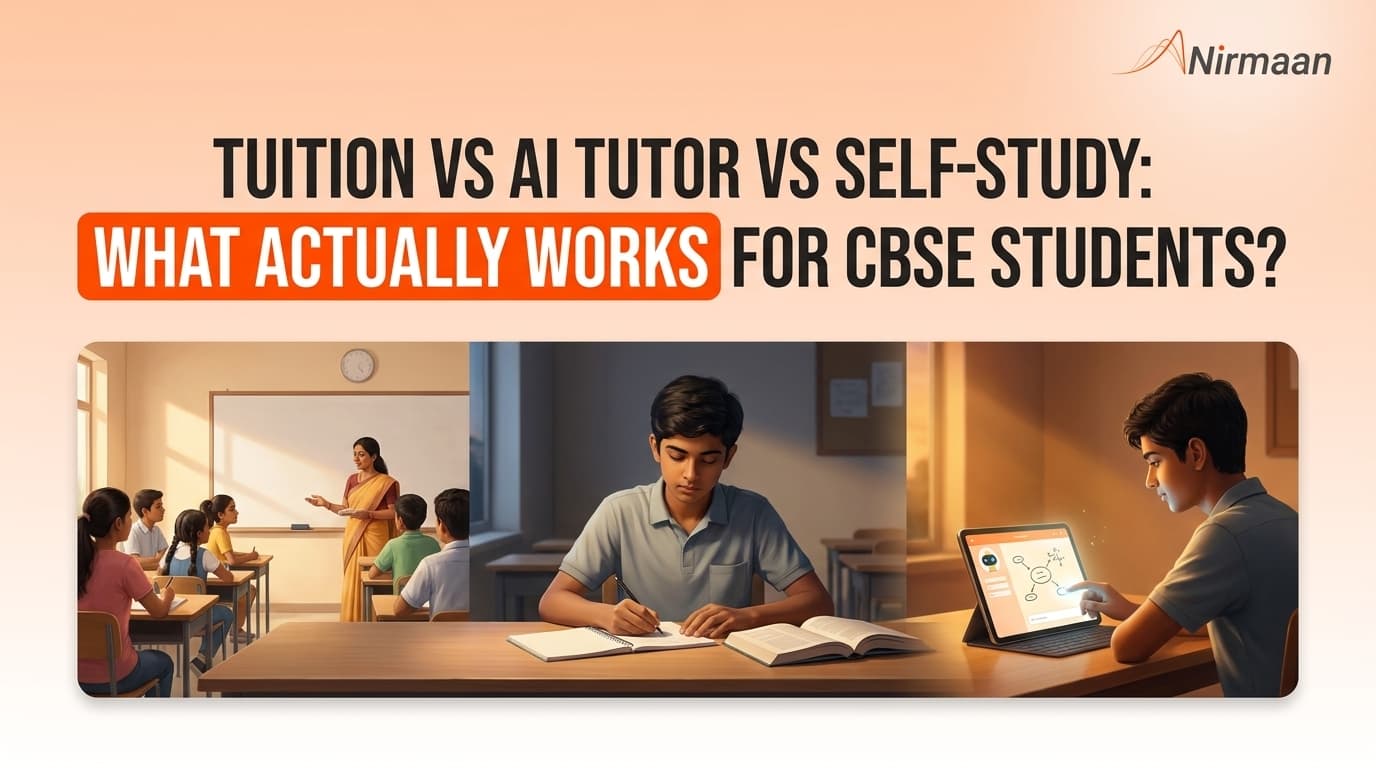
It's 9 PM on a Tuesday. Riya, Class 9, CBSE, is sitting with her Science notebook open to a chapter on chemical reactions she "did" three days ago in tuition. Her mother walks in with tea and asks the question every Indian parent has asked at least once:
Beta, did you understand it in class today?
Yeah, ma. I got it.
Two minutes later, asked to explain why zinc reacts with dilute sulphuric acid, Riya goes quiet.
She's not lazy. She's not careless. She sat through the tuition class, took the notes, even solved the practice questions with the tutor watching. But somewhere between
I copied it down
and
I actually understand it
something didn't transfer. And that gap — not the number of hours studied — is what actually decides whether a CBSE student does well or struggles.
This is the real question parents are asking when they type "tuition vs self study vs AI tutor" into Google at midnight. Not which one sounds more modern. Which one closes that gap.
Let's actually answer it.
.
Why This Question Is Everywhere Right Now
India's private tuition market crossed roughly $4.4 billion in 2025 and is projected to nearly double by the early 2030s. That's not a niche industry anymore — it's a parallel education system that runs alongside every CBSE school in the country. Estimates suggest well over half of Indian school students take some form of tuition outside class, and the number climbs sharply once board exam years hit.
At the same time, AI-based learning tools have gone from a curiosity to something CBSE itself is pushing, with the board's Computational Thinking and AI curriculum now mandatory across Classes 3 to 8. Parents aren't choosing between "old-school" and "new-school" anymore out of curiosity — they're being pulled into the decision whether they like it or not.
So here's what each option is actually good at, where it quietly fails, and what CBSE toppers and researchers alike keep pointing back to.
.
Tuition: Structure and Discipline, But a Ceiling You Can't See
Tuition works because it works the way a classroom is supposed to — except with fewer students and, ideally, more attention per child.
What it genuinely delivers:
A fixed schedule that forces consistency, especially useful for students who won't self-start
A human who can read frustration on a face and adjust tone, not just content
Peer pressure that, used well, keeps a student accountable
Exam-pattern familiarity from a tutor who's seen ten years of CBSE papers
Where it quietly breaks down:
A tuition batch of 15-20 students moves at one pace — usually the pace of the middle of the class. If Riya is ahead, she's bored and disengages. If she's behind, she nods along in class and drowns silently, exactly like she did in school. The tutor cannot rewind and re-explain a concept 12 different ways for 12 different students in a 90-minute session. And because tuition is graded on "did they finish the syllabus," not "does Riya actually understand oxidation-reduction," the gap can survive undetected for months — right up until a test reveals it.
There's also a cost ceiling most families quietly hit. Quality one-on-one tutoring is expensive enough that most households settle for group batches, which brings back the exact "explained once, moved on" problem tuition was supposed to solve.
Tuition is excellent for structure and exam strategy. It is not built to find or fix an individual student's specific gap.
.
Self-Study: Builds Independence, But Only If the Foundation Is Already Solid
Every topper interview says some version of "I did most of my real learning on my own." It's true — and it's also the most misleading advice a struggling student can hear.
What self-study genuinely builds:
Real ownership of the material — you remember what you fight to understand
Time management and prioritization skills that no tutor can hand you
The ability to revise efficiently, which is what actually wins boards, not first-pass learning
Where it quietly breaks down:
Self-study assumes you already know what you don't know. That's a huge assumption. A student stuck on a wrong foundational concept from Class 6 will keep building incorrect logic on top of it in Class 9, with zero external signal that anything is wrong — because the textbook explains it the same way it always has, and YouTube gives you a hundred videos in someone else's teaching style, not yours.
Self-study also has no answer for the 11 PM doubt. The moment of confusion happens, motivation to solve it is highest right then — and by morning, both the confusion and the motivation have usually faded into "I'll ask someone later." Later rarely comes.
Self-study is the single most powerful tool for a student who already has strong fundamentals. For a student with real learning gaps, it can quietly widen them.
.
AI Tutor: Built Specifically for the Problem the Other Two Can't Solve
Here's the uncomfortable truth neither tuition centers nor self-study advocates like to say out loud: the actual bottleneck in most students' learning isn't effort, hours, or even intelligence — it's an undetected gap from a concept that was never fully understood, sitting quietly under everything built on top of it.
That's a diagnosis problem before it's a teaching problem. And it's exactly what a well-built AI tutor is designed to solve.
A genuine AI tutor — not a chatbot, not a video library — doesn't just answer the question you ask. It notices why you asked it. It can tell the difference between a student who forgot a formula and a student who never understood the concept the formula came from. It re-explains the same idea three different ways — through conversation, through a diagram, through a worked example — until it actually clicks, and it checks that it clicked before moving on, the way the best human tutor you ever had would, except available at 11 PM on a Tuesday when Riya is stuck on chemical reactions and everyone else in the house is asleep.
What a strong AI tutor genuinely delivers:
Availability the moment the doubt happens, not whenever the next tuition slot is
A running model of exactly where a student's specific gaps are — not "did the class finish", but "does this student actually understand this"
Infinite patience to re-explain without the social pressure of asking "one more dumb question" in front of 15 batchmates
Cost that scales far below one-on-one human tutoring, because it isn't limited by a tutor's clock
Where it has real limits:
An AI tutor doesn't replace the discipline a strict tuition schedule enforces, and it can't replicate the mentorship, encouragement, or life advice a genuinely good human teacher provides over years. A student with zero self-motivation still needs some external structure — human or otherwise — to actually sit down and use it.
.
So What Actually Works? The Honest Combination
Stop thinking of this as three competing options. Think of it as three different jobs:
Self-study is where retention actually happens — the fighting-to-understand part that makes something stick.
Tuition or a good teacher provides structure, exam strategy, and human mentorship over the long run.
An AI tutor is where the gap gets found and fixed — the moment of confusion gets resolved before it compounds into a permanent hole in a student's foundation.
The students who consistently do well aren't the ones who picked the "best" single method. They're the ones whose gaps get caught early, wherever that catching happens.
That's the real shift happening in Indian education right now. Not "AI replacing tuition" or "self-study is the only real way to learn" — but a slow recognition that the missing piece all along wasn't more hours of teaching. It was someone, or something, actually noticing where a specific student got stuck, and staying with them until it clicked.
That's the gap Riya's tuition class didn't catch. It's the gap her textbook couldn't see. And it's the exact gap a tutor that actually understands how she learns — not just what chapter she's on — is built to close.
.
Nirmaan is an AI tutor built for exactly this: it finds the specific gaps in how a student thinks, then teaches through conversation and visuals until the concept truly clicks — available whenever the doubt happens, not whenever the next class does.