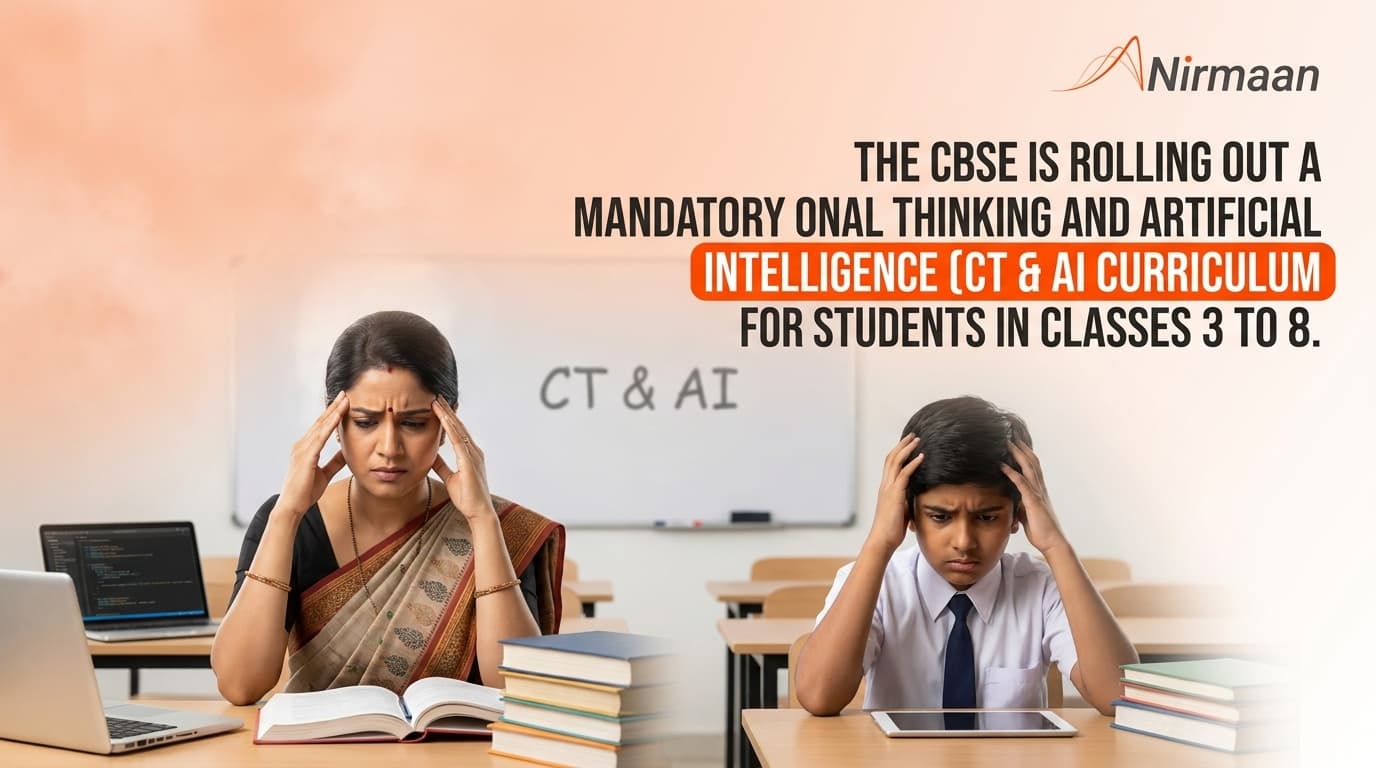
Over 20 million children in Classes 3 to 8 across CBSE-affiliated schools are now required to study Computational Thinking and Artificial Intelligence, effective the 2026–27 academic session. India's largest school board just placed algorithmic literacy on par with multiplication tables. For parents, this sounds like progress. For principals, it sounds like a mandate they didn't get resourced for.
.
The Policy Sounds Like Science Fiction...
On paper, it's genuinely ambitious. CBSE's Circular Acad-15/2026 (April 1, 2026) launched the Computational Thinking and Artificial Intelligence (CT & AI) curriculum for Classes III–VIII, developed with NCERT and an expert committee drawing on IIT Madras, MNIT Jaipur, and Azim Premji University. Resource books for students and teachers followed shortly after (Circular Acad-18/2026).
The curriculum builds four core competencies progressively: decomposition, pattern recognition, abstraction, and algorithmic thinking — with AI literacy layered on top from Class 6 onward.
.
Importantly, CBSE has explicitly designed this to be platform-agnostic — no mandated software, no required devices at the primary level. That's a deliberate, sensible design choice. It's also where the gap between design intent and ground reality opens up.
Stunning ambition. The kind of thing that wins headlines in Davos.
.
... The Infrastructure Doesn't Match the Ambition
Here's what the government's own data shows.
According to UDISE+ 2023-24, 57.2% of Indian schools have functional computers — meaning roughly 43% still don't. The gap is sharper in government schools specifically: functional computer availability there sits at around 44%, compared to over 70% in private unaided schools. Internet access lags further behind, at under 54% nationally. These numbers have improved steadily since 2018-19 (when functional computers stood near 33%), but "improving" and "ready for a mandated national curriculum this year" are different claims.
CT & AI doesn't strictly require heavy infrastructure at the primary level — CBSE built it to work with pencil, paper, and puzzles for Classes 3-5. But the AI literacy component for Classes 6-8, and any school wanting to go beyond the bare minimum, does need some combination of reliable power, functioning devices, and internet — exactly the resources that are unevenly distributed, with rural and government schools consistently behind urban private ones.
The teacher-readiness question is murkier and deserves honest framing: multiple surveys over the past few years have flagged low teacher confidence with educational technology, though we couldn't verify a single definitive national figure worth quoting as gospel. What's not in dispute is the structural reality: CBSE's own implementation guidance assigns CT instruction to existing subject teachers (Math teachers at the primary level, using a companion resource book) rather than requiring specialist hires. That's efficient on paper. It also means a teacher who has never studied AI is now expected to teach AI-adjacent concepts using a resource book and whatever training her school manages to organize.
.
Show Me the Money (That Isn't There)
CBSE's own materials emphasize that the curriculum requires no specific platform and "no additional cost to schools." That's true for the bare compliance version. It becomes a different story the moment a school wants to do this well rather than just document that it happened.
What we know:
No centralized CBSE budget for hardware or connectivity upgrades tied to this rollout
No mandatory certification for CT & AI instructors — subject teachers absorb it into existing workload
Assessment leans on competency-based, project-style evaluation rather than a standardized test, which is pedagogically sound but harder to implement consistently across 25,000+ schools with wildly different resourcing
The policy assumes a level of implementation capacity that a Delhi private school and a government school in rural Jharkhand simply do not share equally
Same syllabus. Very different starting lines.
This is where the EdTech sector shows up, unevenly. India's K-12 edtech market is projected toward multi-billion-dollar scale by 2026, and platforms are moving fast to sell "AI for schools" packages. Quality varies enormously — some are genuinely well-designed to CBSE's actual framework; others are repackaged generic content with an "AI" label bolted on. Principals fielding vendor pitches are often being sold a product demo, not asked what their school actually needs.
.
The Real Risk: Literacy Debt Compounding Into AI Debt
The deeper concern isn't a missing lab. It's what happens when a curriculum designed around understanding gets compressed into ritual under pressure.
India's foundational literacy numbers are already a known, longstanding challenge — ASER's household surveys have tracked this for years. As recently as 2022, roughly 43% of Class 5 students could not read a Class 2-level text, a decline from 2018 levels. Layering computational abstraction on top of a literacy base that's already strained is not automatically a problem — CT is largely non-verbal, visual, and puzzle-based by design at this age — but it does mean schools have almost no margin for a poorly implemented rollout on top of everything else they're already managing.
Under-resourced, under-trained implementation tends to produce a specific failure mode: definitions get memorized instead of understood, projects get templated instead of built, and students walk away having "done AI" without any real conceptual foundation. The mandate's stated goal is to democratize computational thinking. Implemented unevenly, it risks doing the opposite — reinforcing that technology is something other people build, while a smaller, better-resourced slice of students actually gets it.
.
The Verdict
Mandating CT & AI literacy is the right call, built on a genuinely thoughtful curriculum framework. The execution risk isn't in the design — it's in the resourcing gap between a national mandate and 25,000+ schools with very different starting points.
Parents' questions should shift from "Is my school teaching AI?" to "Who is teaching it, with what training, and how will you show me my child actually understands it — not just completed a project?"
Principals are navigating a real bind: compliance timelines without a matching infrastructure budget, ambition without uniform capacity to deliver it.
And in schools without a dedicated computer teacher, it's very likely a Math teacher — who has never written a line of code — is the one making this curriculum work. Or not.
.
References
UDISE+ 2021-22 and 2023-24 School Education Statistics, Ministry of Education, Government of India
India EdTech market analysis, industry reporting, 2025-2026
P.S. We're watching this unfold from the inside. At Nirmaan, we're building an AI that maps what each child actually understands, not what the curriculum claims they should. Because the gap between mandate and mastery is where learning actually lives. Or dies.